Built for Risk, Not Rents: Value and the EU AI Act
First published on LinkedIn
For years, Mariana Mazzucato has argued that we must restore the concept of value to our understanding of economics (and economy). She claimed, in short, that current theoretical consensus – that value equals price – leads to unbalance between “value creation” and “value extraction”. In other words, price itself cannot be a measure of value.
If we apply her framework to Big Tech, the tech platforms were built using state-funded technologies (Internet, GPS, touchscreen etc.), but value, or wealth, is almost entirely extracted by the private sector.
The story is similar for generative AI: large models are trained on data that is public or at least was created by a multitude of diverse entities: users on forums, book authors, researchers, Wikipedia contributors, open source software developers, etc. This created value – similar to what Yochai Benkler has described as commons-based peer production – is now recaptured by others.
However, some studies (What is Generative AI Worth? by Brynjolfsson, Collis, Eggers) argue, that large part of the value extracted from using generative AI is appropriated by the consumers, not by the model owners. Interestingly, the same team, using the same methodology (Willingness to Accept study) reached similar results for social media – claiming large consumer surplus from using these platforms. Even earlier, economist Hal Varian, at the time working for Google, presented Google services as a source of significant consumer surplus.
This similarity is no accident: the publicized consumer surplus reframes platform power as generosity. For social media and other “Web 2.0” technologies, the promise of autonomy and empowerment was not fulfilled (ask Shoshana Zuboff).
How is it going for generative AI? Most platforms are heavily concentrated – OpenAI, Google and Anthropic together hold about 90% of generative AI consumer market making it ripe for rent-seeking value extraction patterns we know from the social media revolution.
If conditions are the same, is regulation any different?
The EU has tried a different approach to regulating AI (as opposed to social media platforms). Intending to regulate the AI before it’s too late, the Union introduced the AI Act. The Act itself isn’t aimed at the technology, only at the risks of using it in certain contexts. Yet it does carry one value-related consideration: the open-source exception.
The AI Act itself is obviously not a strictly policy document. The recitals (eg. Recital 102) vaguely state that open source software “can contribute to research and innovation in the market and can provide significant growth opportunities for the Union economy”. General purpose AI models released as open source are then relieved of some obligations, unless they pose “systemic risk” (which broadly means “are big enough” – frontier models fall into this category).
However, focusing on risk only without considering value makes an awkward choice for promoting open source models.
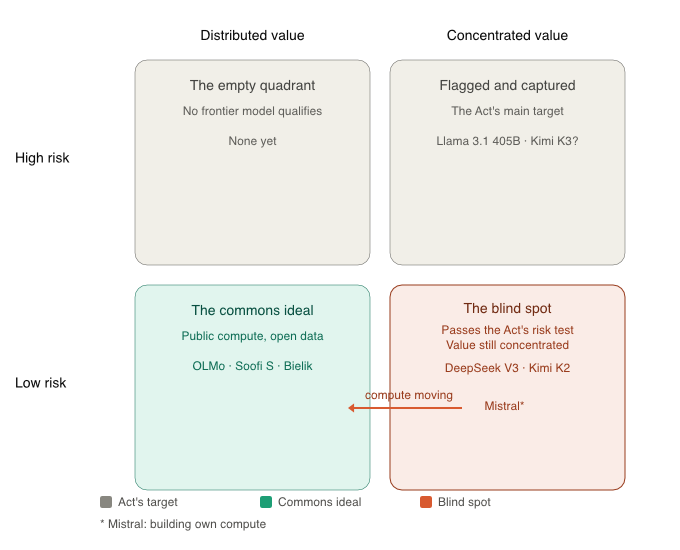
The chart above places several open-weight models in the value-risk matrix. The list is obviously not exhaustive. High/low risk is an AI act category, while distributed/concentrated value is my intended Mazzucato matrix.
To actually contribute to EU research and innovation, models should be more open and provide real opportunities to be used independent of concentrated platforms. Concentrated, meaning in this context that model provider opens the model weights, but still controls data and training. Moreover, many open weight models are in practice bound to well-known hyperscalers and their infrastructure.
The top-left quadrant is empty. This is not an omission: so far there is no open model big enough to pose a systemic risk. Transparency and scale seem to be mutually exclusive at the moment. The EU’s European Technological Sovereignty Package might pave a path to creating a frontier, distributed-value model. The EU’s Frontier AI Grand Challenge has already selected a candidate: the EUROPA consortium, tasked with a 400B+-parameter, fully open, all-24-language model. It remains unbuilt.
In the top-right we have AI Acts target models: open-weight, posing systemic risk, but they’re still concentrated and the Act is not meant to remedy that.
The bottom-left is where actual open source efforts succeeded. Still, notice that OLMo, Soofi S or Bielik are being developed by non-profits and/or publicly co-funded. Full disclosure is both an ideological choice and a public requirement. Soofi directly states it aims to create a frontier model – which might place it in the top-left quadrant.
The bottom right is now where most open weight (open-source according to the AI Act) models sit. They provide technical advantages over closed models, but without clear value-related policy, they won’t make a meaningful impact on the generative AI landscape in the EU. Recently, Mistral announced it will build and use European data centres for its models. It is a step in the right direction for sovereignty, but has little impact on the actual value capture.
The Act seems to be a wrong tool for the job. It was built to deal with risk, not with economic rents. These two are different failure modes.